
North Billerica Train Station
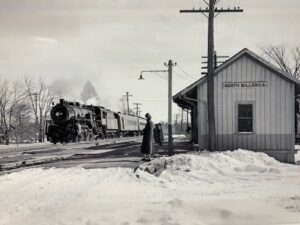 In 1829, the route of the Boston and Lowell Railroad was surveyed and one year later the Massachusetts Legislature granted approval for the project. By June of 1835 a single-track linking Boston and Lowell was completed, ranking the Boston and Lowell Railroad Corporation among the earliest steam railways in the United States. Within three years a second track was added. Initially the enterprise served passengers, but soon after freight cars were included. The directors of the B and L concentrated on erecting stations at each terminus of the line. Intermediate stops were not immediately planned, but provisions for passengers to flag the train enroute were allowed. Very quickly scheduled stops between Boston and Lowell were established. One such locale was at Billerica Mills (North Billerica), where there were a number of manufactories adjacent to the millpond and dam on the Concord River within eye shot of the B and L’s tracks.
It is believed that the first depot was erected at this site about 1840. In “North Billerica Recollections” this station (located south of the present depot was described as a small box-like structure which by the late 1860’s was moved to the east side of the tracks for use as a store house.
During ensuing years continued commercial and industrial development in the vicinity created greater demand for passenger service which resulted in the little station’s becoming inadequate to accommodate the B and L’s clientele. On December 28, 1866, the Boston and Lowell Railroad Corporation purchased from the C. P. Talbot Company the lot upon which today’s depot is set. During the next 8 to 12 years the main portion of the present depot is believed to have been built. Some reports suggest that the construction process was accomplished in stages as needs arose.
We are indeed fortunate that through the intervention of several concerned sources this old building is being saved, for it symbolizes the opportunity which the railroad provided for the expansion of industry and prosperity particularly in North Billerica. In providing easily accessible, affordable transportation for incoming raw materials and outgoing finished goods, it also opened up for residents’ opportunities for choice in work, higher education, culture and recreation. For many a generation the depot itself touched perhaps every life in North Billerica in some positive way. If it had been demolished instead of saved, an integral part of North Billerica would have been lost.
This article, by Margaret Ingraham, was extracted from the Spring 1998 edition of The Yankee Doodle Times, newsletter of the Billerica Historical Society.