
Amos Wyman House
The Revolutionary War of deeds, which began in earnest on the 19th of April 1775, was preceded by a long and no less significant war of words, with Boston as the principal center of agitation and objective of royal coercion. Fully living up to her reputation as the “Metropolis of Sedition”, Boston was where the first British regiments were sent in 1768 to enforce, what seemed to the inhabitants, the harsh and tyrannical measures of a new British colonial imperialism and to quell the rebellious rumblings of a people possessed not only of an ardent passion for freedom but a jealous knowledge of self-government.
The presence of the royal troops provoked the famous Boston Massacre of March 5, 1770. They were removed from the town temporarily, but were back again in greater numbers after the port was closed by act of Parliament following further defiant demonstrations by mobs and the populace in general. Of these demonstrations, the Boston Tea Party of December 16, 1773, was an illustrious example.
Tensions between patriots and the soldiery had mounted to the breaking point and more reinforcements were on the way to aid in the increasingly difficult task of maintaining the King’s rule when General Thomas Gage, the military governor of the province, decided to take more positive measures to curb the bold enterprise of the patriot leaders. The most important of these measures for which preparations began to be made in March 1775, was a plan to send an expeditionary force to Concord to destroy powder and other military supplies.
Moving along to the famous night of April 18 & 19, 1775, the much-storied ride of Paul Revere to warn the citizenry of Massachusetts of the British expedition to Concord, came to an abrupt end when he was seized in Lincoln. After an interrogation, Revere, along with three Lexington scouts previously captured, were let loose near the village of Lexington and the British patrol rode off in haste toward Menotomy. Revere made his way across a “burying ground and some pastures” to the Hancock–Clarke House in Lexington to help with the flight of John Hancock and Samuel Adams.
 These two important patriots, well-known by the British to be major instigators of the colonists’ rebellions, had been warned by Revere days earlier of the British plans for Concord. For their protection they were taken first in a chaise to the house of Captain James Reed in a part of Woburn that is now Burlington, about two miles away, and then a little farther to the home of Madame Jones, a clergyman’s widow. At the latter, they were joined later in the morning by Hancock’s betrothed, Dorothy Quincy, and his aunt, Mrs. Thomas Hancock, who had also been guests of Reverend Jonas Clarke.
The ladies brought with them a “fine salmon” that Hancock and Adams had forgotten in their hasty departure before sunrise. The party was about to sit down and make a meal of it when a Lexington farmer rushed in with a false rumor that the British were coming. They continued their flight and finally sat down to a repast of “cold salt pork and potatoes served on a wooden tray” at Amos Wyman’s in Billerica, a distance of more than four miles from the Lexington parsonage they had left earlier. The battles at Lexington and Concord later that day are unquestionably among the most important events in the American Revolution. The town of Billerica is extremely proud of the role its Minutemen played that day; but it is also proud of this little-known event that sustained these two key leaders of the Revolution and allowed them to complete their mission.
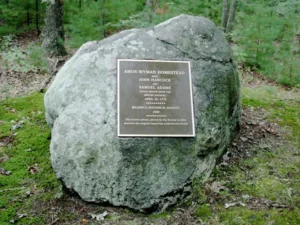
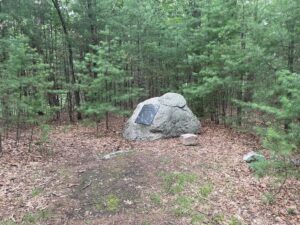
The cellar hole of the Amos Wyman House is still visible and has been marked with a plaque on a nearby rock, placed by the Billerica Historical Society in 1898. It can be reached from the Middlesex Turnpike from the back of the parking lot of 55 Middlesex Turnpike, or by going to the Homewood Suites Hotel and turning left onto a footpath. More detailed directions can be provided by the Billerica Historical Society. Map of the site.
Sources
- The Lexington–Concord Battle Road: excerpts based on research carried out by the Boston National Historic Sites Commission and most recently published in 1977 by Wee Bee Publishing for the Eastern National Park and Monument Association.
- In Retrospect–An Archaeological Excavation of the Amos Wyman Site, Billerica, Massachusetts 1975-1976, by Lillian Thibodeau, Helene Lisy, and Curtiss Hoffman, an account of a project funded by matching grants from the town of Burlington, Massachusetts and the Massachusetts Bicentennial Commission