
The Faulkner Mills
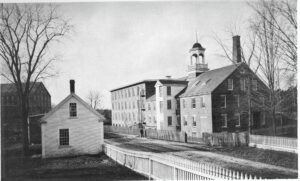 Faulkner Mills is adjacent to the Concord River’s milldam at North Billerica. The area was originally meadow land, and its hay and grass were used by the early English settlers as food for their farm animals.
As it was subject to annual floods, attempts were made to curtail the problem. In 1659 William Sheldon received permission to construct a mill to grind corn, but it was not until 1708 that Christopher Osgood successfully erected an effective dam here. All future owners of this spot trace their deed to Osgood and his dam. By the end of the 18th century there were five grist mills, three sawmills and one fulling mill at work here.
During the period of the Middlesex Canal’s operations, its Proprietors were in charge of the area and continued to run the mills as well as a fishway. For them, Loammi Baldwin replaced Osgood’s old worn dam with a new one near the current dam at Faulkner Street bridge. In 1828 the Proprietors again built a new dam on this site. At the Canal’s demise, the control of the area passed to two families: the Faulkner’s and the Talbots.
Francis Faulkner had run a textile mill in North Billerica since 1811. He began with a fulling mill but eventually had several other buildings. Unfortunately, these were destroyed in 1818 by fire. Undaunted, Faulkner rebuilt his business and in 1825 purchased in England new looms run by waterpower. By now, his son James Robbins Faulkner had joined his father’s business. Additional land and buildings were added to their original holdings, and the firm went from manufacturing cloth to flannel. A steam boiler was added in 1834. Two years later a second fire destroyed much of the property.
As a result, the three-story brick factory familiar today was constructed, with its Georgian-style cupola; a four-story brick edifice which became the Mill’s main building was added during the Civil War. The business prospered: in the late 1870s it provided work for 70 men and women. This staff included several young girls, and so James’s three daughters established for their education the Faulkner Kindergarten. About the time of the First World War, the company was re-organized as the North Billerica Company. It had a staff of 135, who produced wool blankets and various colored cloth. In spite of the changing economic conditions that now began to affect New England’s mill business, the company remained in operation until the 1980s. For some time after the plant closed, the structures remained vacant, until their current rebirth.
This article, by Alan Seaburg, came from the website of the Middlesex Canal Association.