
Patriots Day
2025 Billerica Historical Society’s Patriot Day activities
Date: April 13, 2025, 1pm to 4pm.
Location: 36 Concord Rd., Billerica, MA. Flyer information.
Billerica – Patriots Day History
Merriam’s Corner – April 19th, 1775, the beginning of the American Revolution
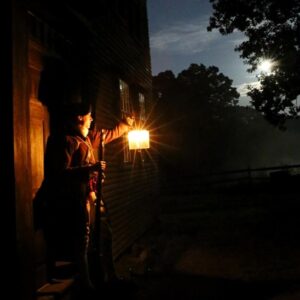 On the night of the 18th the British force moves out of Boston to search for arms in Concord as well as looking for “treasonous” leaders of the patriot movement. This action triggered an alarm to warn the countryside of the impending danger of the “regulars” being out. The alarm quickly spread far and wide through a network known as “The Committee of Correspondence”.
The first alarm rider arrived in Billerica at about 2AM on the morning of the 19th. The word spread quickly throughout the town. Soon members of the Minutemen and the standing militia began to gather on the town common and Pollards tavern, just north of the common. Sometime in the early morning of the 19th, the troops under the command of Col. William Tompson, moved out on their march to Concord.
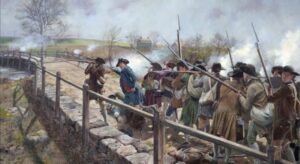
The Billerica men arrived at Merriam’s corner and took up positions along with troops from Woburn and Reading while waiting for the British who left Concord center just after noon for their return to Boston. As the British column crossed a bridge over a small creek swollen from the spring rains, the colonial men fired on the rear of the British column starting what we now call the fight of “Battle Road”. This is considered the first offensive action of the Revolutionary war and Billerica was a major participant in this action.
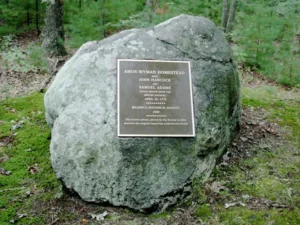
Amos Wyman House – April 18 & 19, 1775, the continuation
 The Revolutionary War of deeds, which began in earnest on the 19th of April 1775, was preceded by a long and no less significant war of words, with Boston as the principal center of agitation and objective of royal coercion. Fully living up to her reputation as the “Metropolis of Sedition”, Boston was where the first British regiments were sent in 1768 to enforce, what seemed to the inhabitants, the harsh and tyrannical measures of a new British colonial imperialism and to quell the rebellious rumblings of a people possessed not only of an ardent passion for freedom but a jealous knowledge of self-government.
The presence of the royal troops provoked the famous Boston Massacre of March 5, 1770. They were removed from the town temporarily, but were back again in greater numbers after the port was closed by act of Parliament following further defiant demonstrations by mobs and the populace in general. Of these demonstrations, the Boston Tea Party of December 16, 1773, was an illustrious example.
Tensions between patriots and the soldiery had mounted to the breaking point and more reinforcements were on the way to aid in the increasingly difficult task of maintaining the King’s rule when General Thomas Gage, the military governor of the province, decided to take more positive measures to curb the bold enterprise of the patriot leaders. The most important of these measures for which preparations began to be made in March 1775, was a plan to send an expeditionary force to Concord to destroy powder and other military supplies.
Moving along to the famous night of April 18 & 19, 1775, the much-storied ride of Paul Revere to warn the citizenry of Massachusetts of the British expedition to Concord, came to an abrupt end when he was seized in Lincoln. After an interrogation, Revere, along with three Lexington scouts previously captured, were let loose near the village of Lexington and the British patrol rode off in haste toward Menotomy. Revere made his way across a “burying ground and some pastures” to the Hancock–Clarke House in Lexington to help with the flight of John Hancock and Samuel Adams.
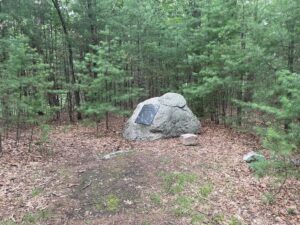 These two important patriots, well-known by the British to be major instigators of the colonists’ rebellions, had been warned by Revere days earlier of the British plans for Concord. For their protection they were taken first in a chaise to the house of Captain James Reed in a part of Woburn that is now Burlington, about two miles away, and then a little farther to the home of Madame Jones, a clergyman’s widow. At the latter, they were joined later in the morning by Hancock’s betrothed, Dorothy Quincy, and his aunt, Mrs. Thomas Hancock, who had also been guests of Reverend Jonas Clarke.
The ladies brought with them a “fine salmon” that Hancock and Adams had forgotten in their hasty departure before sunrise. The party was about to sit down and make a meal of it when a Lexington farmer rushed in with a false rumor that the British were coming. They continued their flight and finally sat down to a repast of “cold salt pork and potatoes served on a wooden tray” at Amos Wyman’s in Billerica, a distance of more than four miles from the Lexington parsonage they had left earlier. The battles at Lexington and Concord later that day are unquestionably among the most important events in the American Revolution. The town of Billerica is extremely proud of the role its Minutemen played that day; but it is also proud of this little-known event that sustained these two key leaders of the Revolution and allowed them to complete their mission.
Patriots Day History
Patriots’ Day is an annual event, formalized as several state holidays, commemorating the battles of Lexington, Concord, and Menotomy, some of the first battles of the American Revolutionary War. The holiday occurs on the third Monday of April each year, with celebrations including battle reenactments and the Boston Marathon.
 In 1894, the Lexington Historical Society petitioned the Massachusetts State Legislature to proclaim April 19 as “Lexington Day”. Concord countered with “Concord Day”. Governor Frederic T. Greenhalge opted for a compromise: Patriots’ Day. However, the biggest battle fought on this day was in the town of Menotomy, now Arlington, Massachusetts. Menotomy was on the Concord Road between Lexington and Concord and Boston. While the fighting was going on in Lexington and Concord, 5,100 militia men arrived in Menotomy from Middlesex and Essex Counties. These men took up positions along the road the British troops would take on their retreat to Boston. They placed themselves in and around houses, stone walls, fields, and barns. The bloodiest fighting of the first day of the American Revolution took place inside a single house, the Jason Russell House, in Menotomy. Eleven militia men died in this house fighting British troops trained in bayonet fighting.
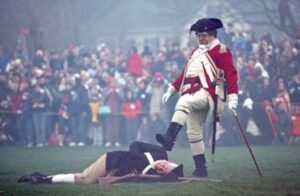 Patriots’ Day was first proclaimed in Massachusetts in 1894 by Gov. Greenhalge, replacing Fast Day as a public holiday. The idea was introduced to the Governor by the statesman from Lowell, Isaac Henry Paige. It was established on April 19, commemorating the date of the Battles of Lexington and Concord and the larger Battle of Menotomy in 1775, and consolidating the longstanding municipal observances of Lexington Day and Concord Day. It also marked the first bloodshed of the American Civil War in the Baltimore riot of 1861, during which four members of the Massachusetts militia were slain and 36 injured. In Menotomy, now Arlington, 25 militia men died, and 40 British soldiers were killed. The dual commemoration, Greenhalge explained, celebrated “the anniversary of the birth of liberty and union”. It is likely that the battles that took place in Menotomy are not as well-known as the smaller battles in Lexington and Concord because the town has had several names since that day in 1775. In 1938, with the generation that had fought in the Civil War largely off the voter rolls, the Massachusetts legislature passed a bill establishing the holiday “in commemoration of the opening events of the War of the Revolution”.
Maine followed Massachusetts in 1907 and replaced its Fast Day with Patriot’s Day. On June 10, 2017, Governor Dannel Malloy signed a bill establishing Patriots’ Day as a statewide unpaid holiday in Connecticut. On April 16, 2018, Connecticut became the 4th state to recognize the holiday.
Description
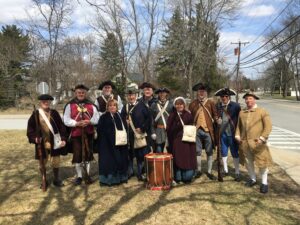 The holiday was originally celebrated on April 19, the actual anniversary of the battles (fought in 1775). Since 1969, it has been observed on the third Monday in April in Massachusetts and in Maine (which until the Missouri Compromise of 1820 was part of Massachusetts). The Monday holiday creates a three-day long weekend. It is also the first day of a vacation week for public schools in both states and a school holiday for many local colleges and universities, both public and private. Observances and re-enactments of the battles occur annually at Lexington Green in Lexington, MA (around 6:00 am) and the Old North Bridge in Concord, MA (around 9:00 am) and in Arlington, MA on the Sunday before Patriot’s Day. Tours are available of the Jason Russell House in Arlington, Massachusetts on Sunday, and Monday. On Monday morning, mounted re-enactors with state police escorts retrace the Midnight Rides of Paul Revere and William Dawes, calling out warnings the whole way.
The most significant celebration of Patriots’ Day is the Boston Marathon, which has been run every Patriots’ Day since April 19, 1897 (except in 2020 and 2021) to mark the then-recently established holiday, with the race linking the Athenian and American struggles for liberty. more…
Patriots Day – Pictures